

Most people make major financial mistakes during this phase. They ignore basic- money rules before signing the papers of buy a home, which leads to heavy financial stress later on-affecting both their work and personal peace.

Nupen Assets Team talked to real home buyers to understand what went wrong. Why did they buy? What pressures did they face? Here is what we learned, stripped of all complicated real estate jargon.
The Trap: Buying for Status or Emotion
Our study showed one clear thing: most people buy homes out of emotion or social pressure, not because they are financially ready.
Here are the most common mistakes people make
- Stretching the budget too far: Buying a house way beyond what their income can comfortably handle.
- Buying too early: Rushing to buy just to show family or society that they have “settled down.”
- Taking the maximum loan: Borrowing as much as the bank allows (up to 80%–90% of the cost).
- Draining every last rupee: Spending their last rupee—and even pulling money out of emergency or retirement funds—just for the down payment.
When you over-borrow, life gets hard. No vacations, no fun outings, and zero peace of mind. A sudden pay cut or medical emergency can ruin your finances, leaving you stuck in a loop of working endlessly just to pay loan installments.
“होम लोन आप जवानी में लेते हो, और होम लोन आपको बुढ़ापे तक ले आता है…सच कहें तो बस एक होम लोन ही है जो हर हाल में आपका साथ निभाता है—जवानी से बुढ़ापे तक, सुख हो या दुख, कभी पीछा नहीं छोड़ता!”

Ask Yourself These 2 Questions First
Before looking at houses, ask yourself:
- Who are you? Are you an investor trying to grow your money, or an end-user who actually wants to live there?
- Why are you buying? Is it an absolute need, or is it just for comfort and social status?
Buying a home should always be a calm, calculated decision based on necessity. As a simple rule, buying makes sense only if you have extra savings or if your monthly rent is more than 20% of your in-hand income.
The Simple Money Rules for Home Buying
If you are buying a home to live in, use these simple maths rules to keep yourself safe 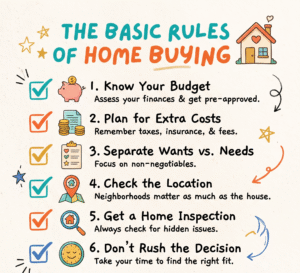
- Monthly EMI: Your loan payment should never be more than 40%–45% of your monthly take-home salary.
- Maximum Price: The house cost should not be more than 10 times your yearly salary.
- Down Payment: Try to pay 45%–50% of the cost from your own money.
- Emergency Fund: Keep at least 3 months of living expenses untouched in your bank account after paying the down payment.
- No Risky Borrowing: Never take personal loans or borrow from relatives just to cover the down payment.
- Retirement Safety: If you must use retirement funds, don’t take out more than 30%.
Understand with an Example
If your take-home salary is ₹ 1 Lakh per month:
- Maximum House Price: ₹1 Lakh × 12 months × 10 = ₹1.2 Crore (including registration and tax).
- Your Own Contribution (Down Payment): ₹55 to ₹60 Lakhs.
- Bank Loan Amount: ₹60 Lakhs.
- Monthly EMI (20 years @ 7.5%): ~₹48,000 (comfortably under half your income).
If you stick to these numbers, owning a home will bring joy, not financial stress.
Now come to another aspect of this blog
“कर्ज़ जितना जल्दी उतर जाए, सुकून उतना ही जल्दी मिलता है।“

3 Ways to Clear Your Loan Faster –
A home loan doesn’t have to follow you for 20 whole years. You can pay it off much sooner and save lakhs in interest.
For a ₹60 Lakh loan for 20 years (EMI ~₹48,336/month):
- Pay 1 Extra EMI Every Year
-
- Result: Closes your loan 3 years early.
- Savings: Saves around ₹9.6 Lakhs in interest.
- Increase Your EMI by 5% Each Year
-
- As your salary grows, increase your EMI payment by 5% every year.
- Result: Clears your loan 7.5 years early.
- Savings: Saves nearly ₹19 Lakhs in interest.
- Extra EMI + Mutual Fund Investment
-
- Pay 1 extra EMI a year, and put the 5% extra amount into a Mutual Fund (SIP) instead.
- Result: Closes the loan 3 years early, saves ₹9.6 Lakhs in interest, and builds an extra ₹31 Lakhs in wealth through investments. Total value saved & created: ₹40+ Lakhs.
Need Help Planning Your Dream Home
Everyone’s financial situation is different depending on age, income stability, and family needs. There is no single rule that fits everyone. 
If you want to buy a home without risking your financial future, our team is here to guide you step-by-step. Please book your first 45 minutes session with our expert.

Leave a Reply